An interactive map of your course in every player's phone: GPS distances, hazards in the line of play, a scorecard for 2–4 players. It opens from a QR code in two seconds — no install and no account. After that it works with no signal, under your club's own branding.
GPS distances◆Front · centre · back of the green◆Hazards in the line of play◆Works with no signal◆Interactive map of your course◆On-site facilities◆Scorecard for 4 players◆Stableford and net◆Shot measurement◆Your own club distances◆9 languages◆No install◆No account◆No player data on a server◆No ads◆The player pays nothing◆Your club's branding◆GPS distances◆Front · centre · back of the green◆Hazards in the line of play◆Works with no signal◆Interactive map of your course◆On-site facilities◆Scorecard for 4 players◆Stableford and net◆Shot measurement◆Your own club distances◆9 languages◆No install◆No account◆No player data on a server◆No ads◆The player pays nothing◆Your club's branding◆
01 The problem
The player stands over the ball and guesses.
The 150-metre marker is somewhere behind you. A bunker past the rise only shows up once you've already hit into it. And tee 4, the driving range or the halfway hut — no app from the store will show a guest any of that, because they only draw 18 fairway corridors and nothing else. So they ask a member of staff. Every second like that is a slower round and a worse impression of your course. Below are six situations from a round — and what Golf Active does with each of them.
Distances “by eye”
The difference between front and back of the green is often 20 m. Two clubs. Golf Active shows all three distances at once and a fourth — to the pin position set for today.
Hidden hazards
A bunker in the line of play and water past the rise, neither visible from the tee. The app lists them with the distance to carry and to clear — before the player reaches for a club.
Golf apps, not your course
The ones from the store are built around the game itself: they count strokes and draw 18 corridors. There is no guide to the club grounds in them. Golf Active also leads to the driving range, the halfway, the pro shop, the restaurant, the car park and the toilets — with opening hours, photos and a phone number.
Getting lost between holes
Getting from the 7th green to the 8th tee is obvious only to regulars. The hole number switches by itself from GPS, and one tap shows the whole course.
Data nobody has checked
A rebuilt green or a moved tee sits in somebody else's database for years — and nobody fixes it, because it is nobody's course. Here it is yours: you change something on the course, you tell us, and we update the map at no extra charge.
Signal that isn't there
Online apps go silent in a dip in the ground. Exactly where you cannot see the flag. Golf Active loads once and keeps working without a network — the map, the distances and the scorecard stay in the phone.
Give your players a modern, interactive map of your course.
02 The app
Seven screens. Zero instructions.
These are real phone screenshots, not mock-ups. The phone is the
only device it's built for — the whole hierarchy is designed for one
situation: a player glancing at the screen for two seconds, in full sun.
01
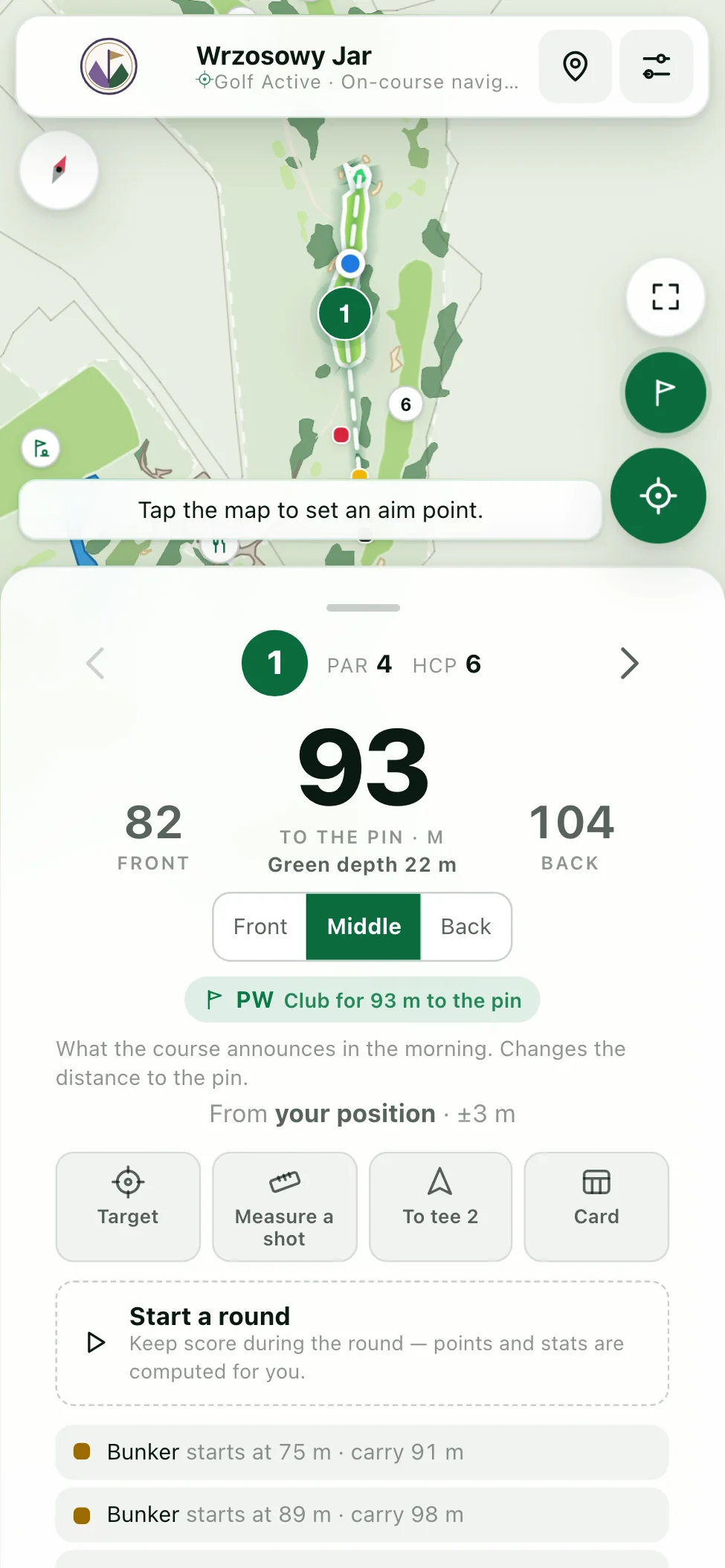
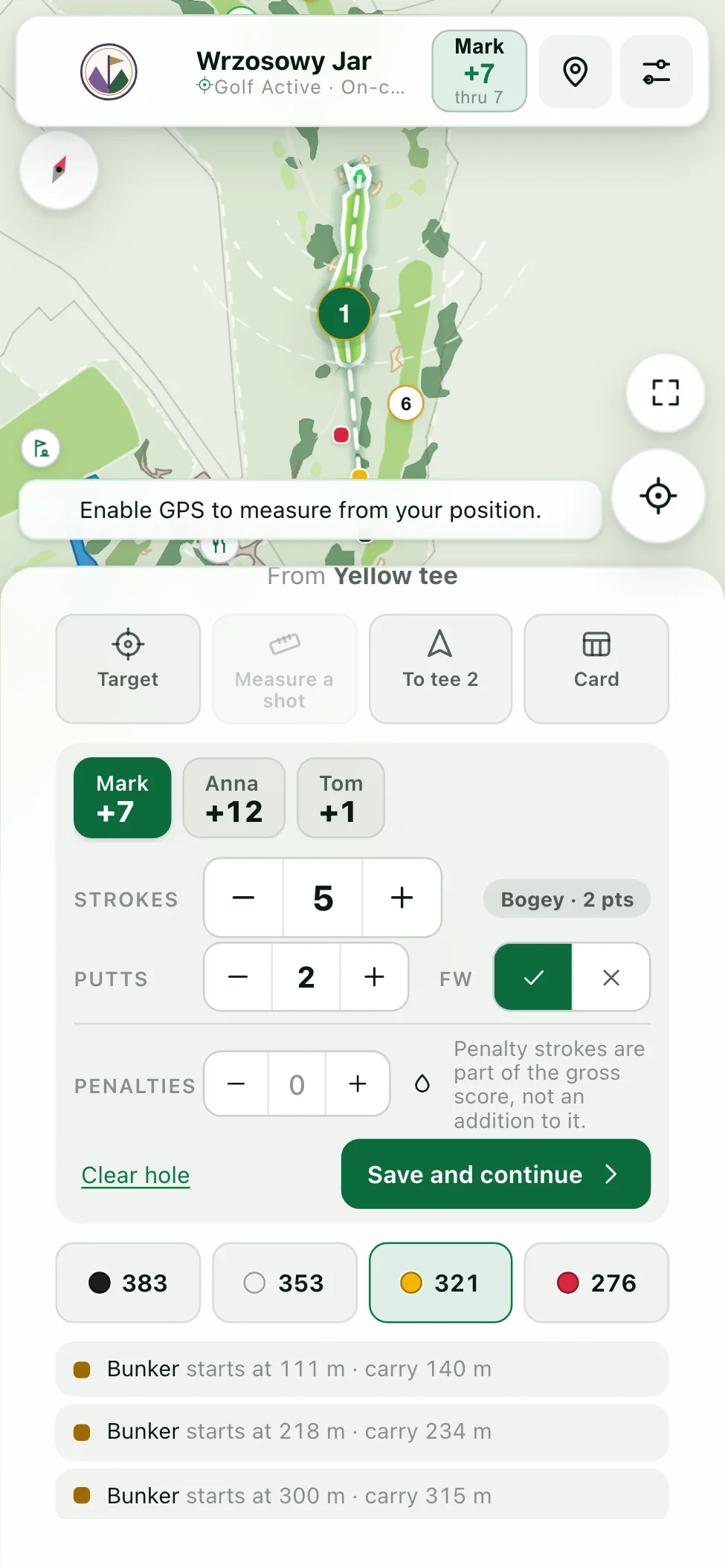
The distance that counts
Front, centre and back of the green — all at once. Centre is the
biggest number, because it's the one players reach for most. The reference
point is the GPS position, or the chosen tee if the player hasn't set off yet.
93 m · accuracy ±3 m
02
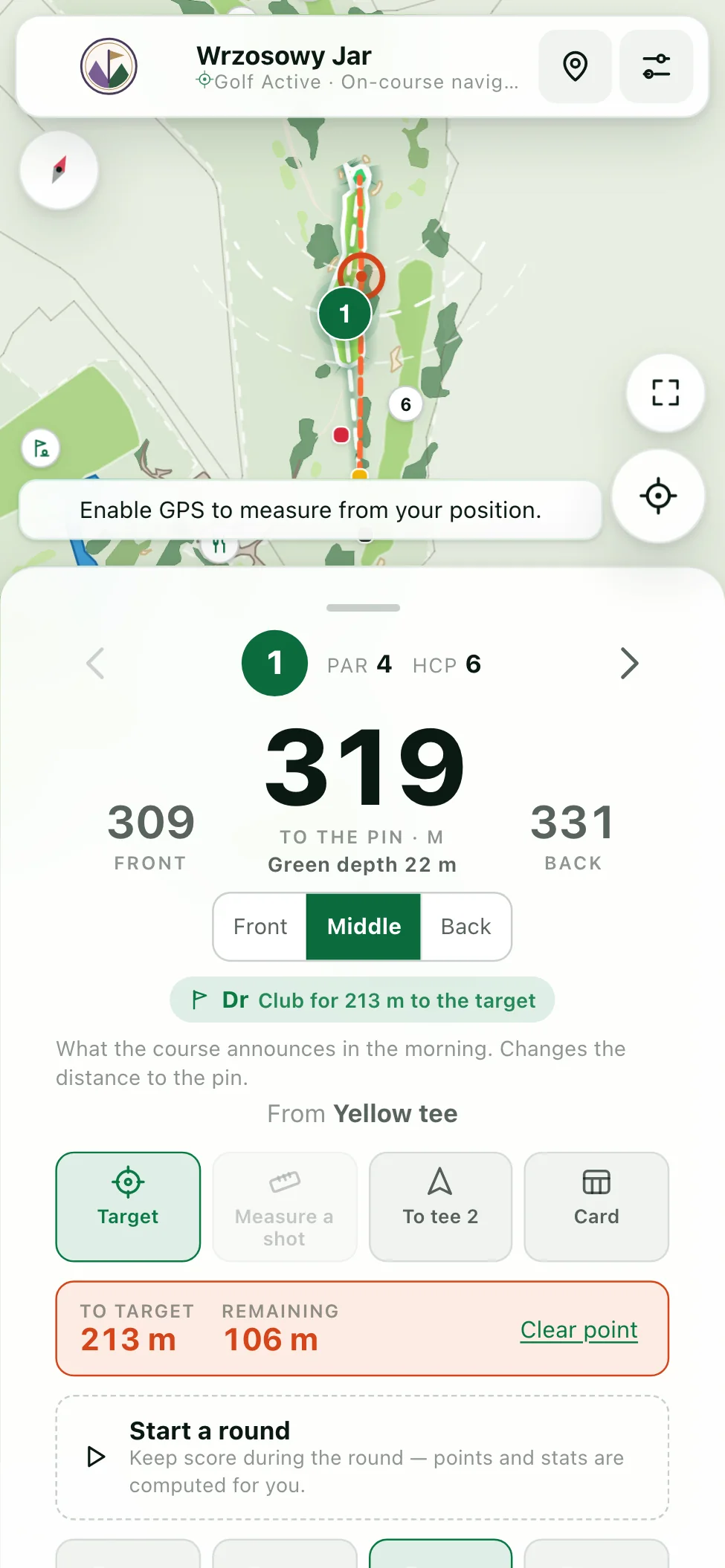
Shot planning and measurement
A tap on the map sets an aim point. The app shows how far you need
to carry it and how much will be left to the pin. Laying up short of the water
stops being guesswork, and measured shots quietly tune the distances
of your own clubs.
To target 166 m · 112 m left
03
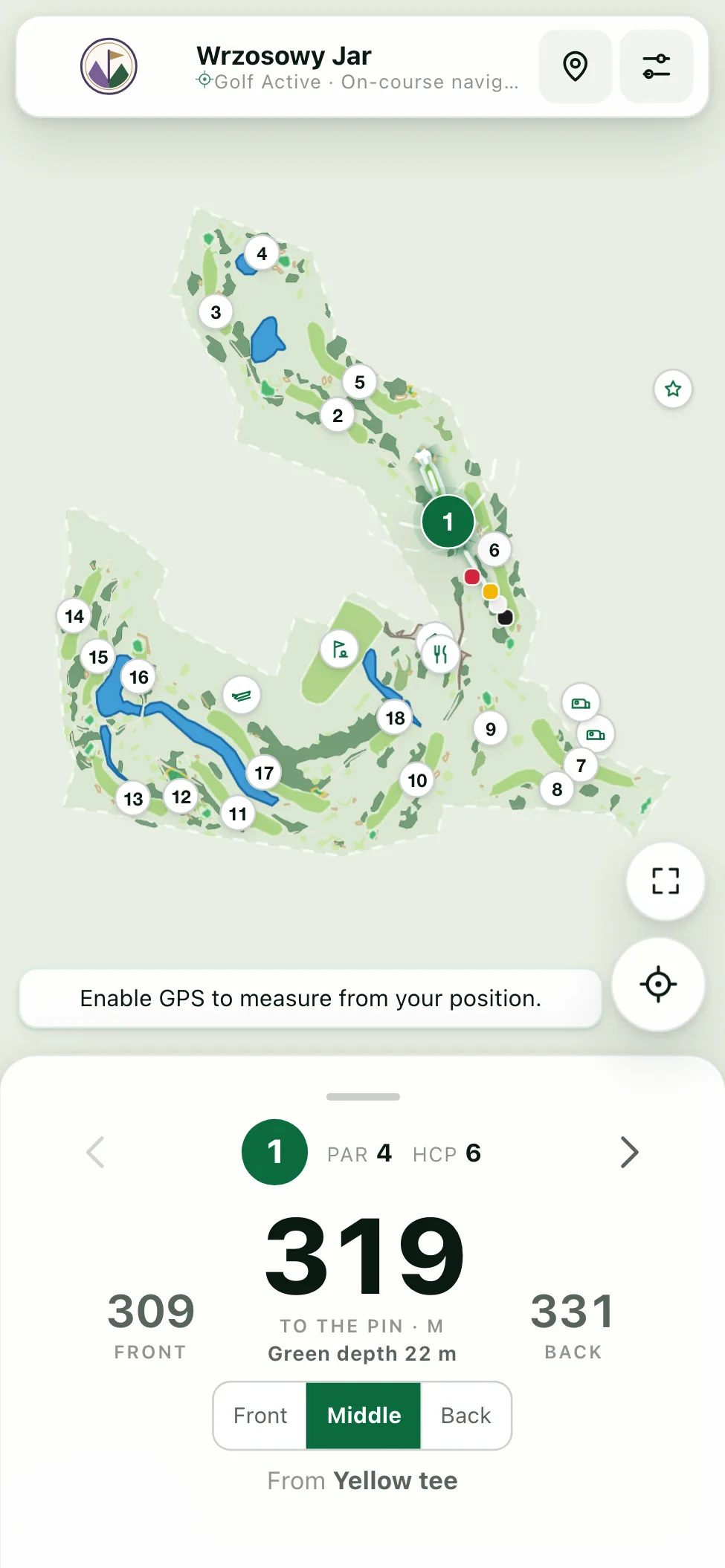
The whole course on one screen
18 holes, each with its number and par, plus the clubhouse,
driving range, restaurant, car park. Tapping a number jumps straight
to that hole.
18 holes · PAR 72
04
A whole flight on one phone
Two, three or four players on a single card. The bar at the top
switches player with one tap, each has their own handicap and their
own tees, so Stableford points are worked out separately for everyone.
That's how most rounds are actually played — and nobody else needs
anything on their own phone.
2–4 players · own handicap and tees
05
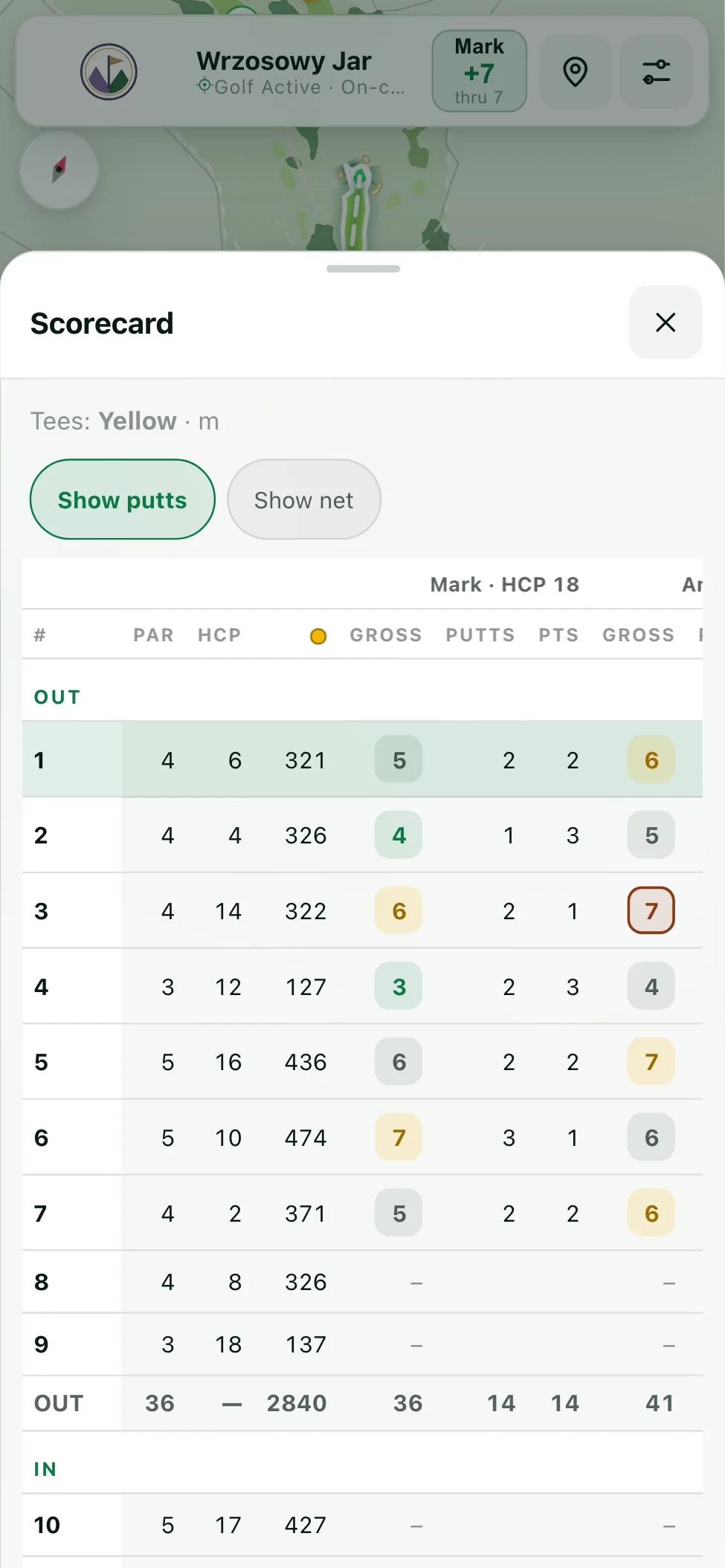
A scorecard that does the counting
Par, stroke index and length for the chosen set of tees, and, as
the round goes on, score, putts, penalty strokes and Stableford points,
hole by hole. Play all 18 holes or just a single nine — for a
nine-hole round the playing handicap is halved, exactly as the Handicap
Rules require. The OUT, IN and total add up on their own.
OUT 36 · yellow tees 2840 m · PAR 72
06
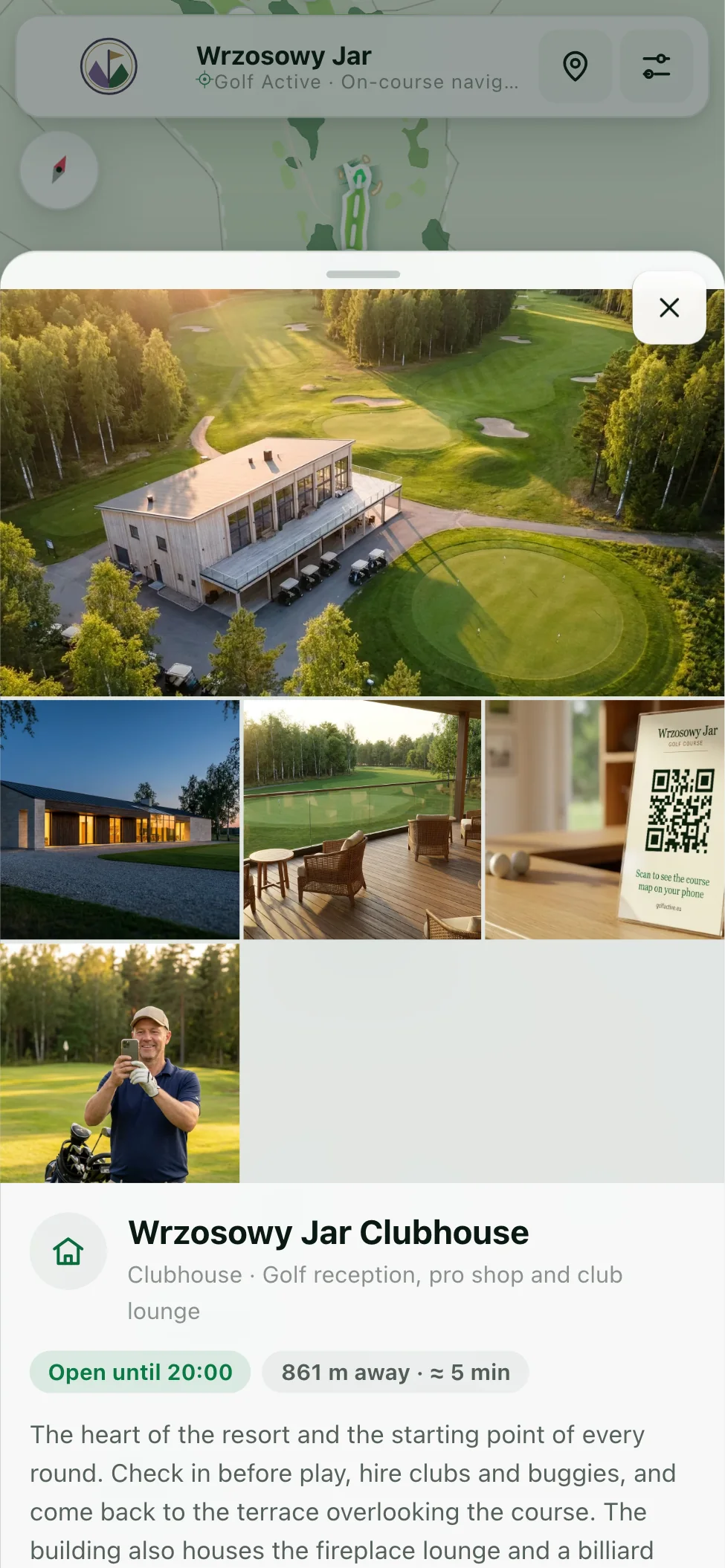
The whole resort, not just the course
Clubhouse, restaurant, driving range, cottages, apartments, a helipad
and a protected natural landmark — with photos and the distance from
the player. Your course starts selling what it has next door.
7 facilities · live distances
07
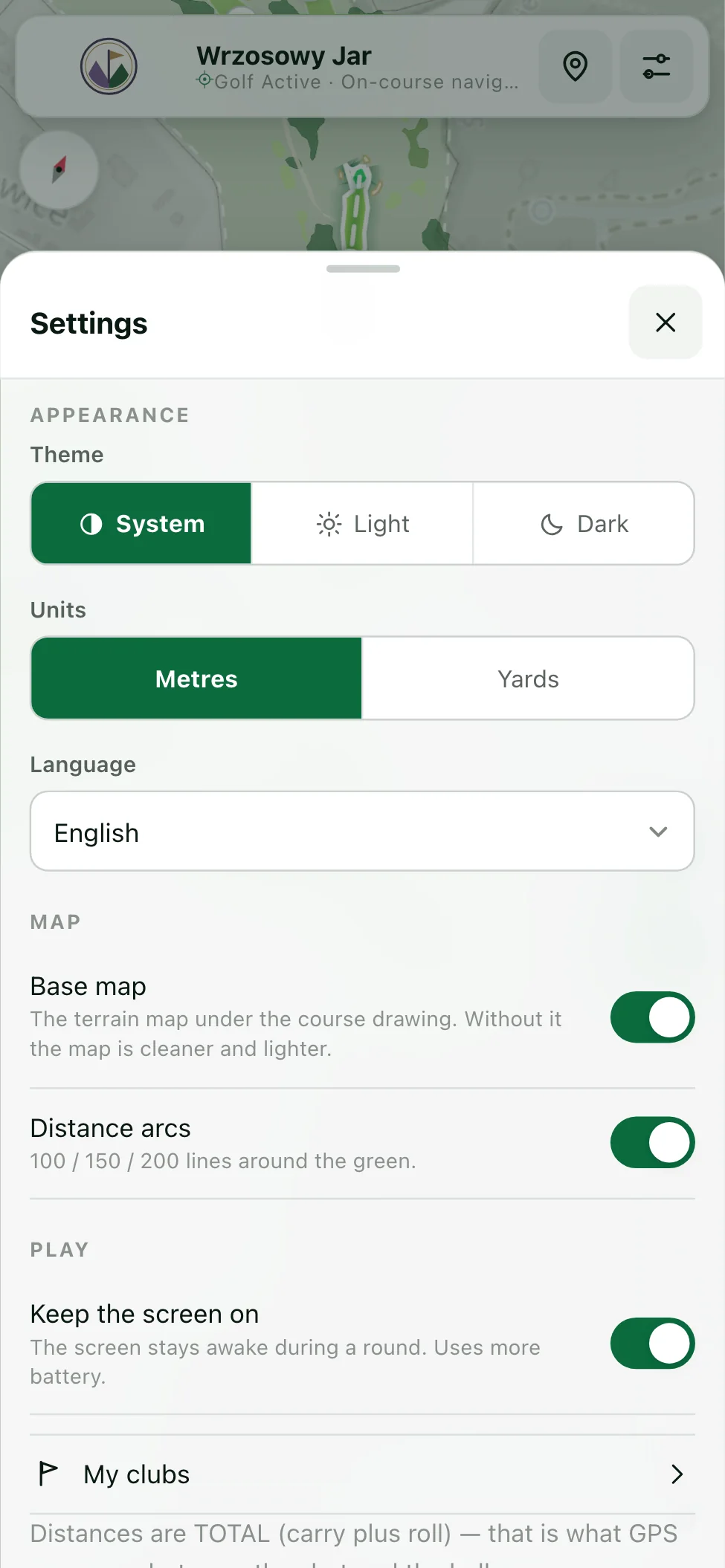
Settings that fit you
Light or dark theme, metres or yards, the map basemap and distance
arcs, keeping the screen awake for the round. It all stays on the
phone.
Light and dark · m / yd
03 Navigation
This is what it looks like mid-round.
Footage of the app running, unedited: switching holes, distances
calculated from the player's position, shot measurement and the card
for the whole round.
01
Distance from wherever you're standing
Front, centre and back of the green recalculate with every step.
Underneath, a club suggestion for the measured distance.
02
Measuring a planned shot
A tap on the map sets an aim point: how far to carry it and how
much is left to the pin. Laying up stops being a guess.
03
The round card on the same phone
Strokes, putts and penalty points with one thumb, for the whole
flight. OUT, IN and Stableford totals add themselves up.
Everything above keeps working when the signal drops — the course map saves
to the phone the first time it's opened, and the GPS receiver doesn't need
the internet.
04 Features
Everything the player and the club need.
On-course GPS navigation
The player's position, distances to the front, centre and back of the
green and to the pin itself — accounting for today's pin position. Metres
or yards, no sign-in and no account. GPS accuracy sits right on the
screen, and wherever the course model is weaker, the app says so itself
— instead of stating every number with the same confidence.
A card for the whole group
From two to four players on one card, on a single phone. Each has
their own handicap and their own tees, so net score and Stableford
points are worked out separately for everyone. Nobody else needs to
install anything or sign up — it's enough that one person in the group
keeps the card. A group scorecard in a store app usually needs everyone
to have an account and be “friends” on it.
Matches your own scorecard
Tee positions aren't read off a drawing or a satellite image —
we calculate them from the published hole lengths. The phone's reading
and the marker on the tee say the same thing by definition, not by
coincidence: an average of 9 cm across all 72 tee positions.
Shot planning
Tap the map — you'll get the carry to your target and the distance
left to the green.
Round tracking and Stableford
Strokes, putts, fairways hit and penalty strokes, entered with one
thumb. Points, net score, scrambling, putts after a GIR and your worst
hole all work themselves out — the data stays on the phone.
A card ready to send
After the round, the card leaves the phone as an image or as text
to paste in — through the phone's own share sheet, with no account
and no server in between.
The arithmetic of golf, without shortcuts
An 18-hole round or just a single nine — for a nine, the playing
handicap is halved, exactly as the Handicap Rules require. Plus handicaps
and allocating strokes by stroke index, too. This is where a mistake
is invisible on screen: the score just comes out one stroke wrong.
The whole resort, not just the eighteen
Clubhouse, restaurant, cottages, driving range — with photos, opening
hours and the distance from the player. A guest sees the terrace when
they're 200 m from the terrace. Someone else's app shows just
the course, and doesn't earn your club a penny.
Built for the player, not for us
Nine languages, metres or yards, light or dark theme — a guest
from abroad gets the app in their own language. Zero adverts and zero
accounts, because we don't live off the player's attention: the club
pays.
Offline mode
Course geometry is saved to the phone the first time it's opened,
and the basemap tiles are cached. In a signal black spot the map and
the distances keep working — GPS doesn't need the internet. The same
thing protects a round from a hosting outage: whoever has already opened
the app plays it to the end.
No install and no account
No App Store, no email, no password, no hundred megabytes.
Scan the QR code and the map's there in two seconds. Anyone who wants
to can add it to their home screen, just like a normal app.
Light and dark theme
Two full colour schemes for the map and interface: high contrast
for full sun, a dimmed one for dawn, dusk and saving battery.
To the middle of the green147m
Hole 7 · PAR 4
On the course
The phone comes out of your pocket three times a hole.
This isn't an app you sit and stare at. It's a tool you reach for
a second at a time and put straight back — exactly how a player already
uses a rangefinder today, just without the rangefinder.
01
Before the shot
How far to the front, centre and back of the green, what's in the
line of play, and how far you need to carry it. Two seconds of looking.
02
After the shot
The score entered with one thumb — yours and everyone else's.
Stableford points work themselves out.
03
After the round
The card leaves the phone as an image to send to the group.
No account, no server in between.
05 Privacy
The map knows your course. It knows nothing about the player.
Built in Europe with privacy by design: a guest scans the code, opens the
interactive map and plays — no account, no email, no cookie consent.
Stays on the player's phone
GPS position — calculated on the device, solely to work out the distance
Scorecard for the whole flight, up to four players
Names, handicaps and tees entered before the round
Club distances and the history of previous rounds
Settings — language, metres or yards, theme
Clearing your browser data wipes all of it.
We hold no copy, because there never was one.
the edge of the phone
Leaves the phone
Nothing.
Not a single byte about the player. There's no server for round
data to reach, and no subcontractor we could hand it to:
our list of data processors has two entries —
website hosting and a mailbox — and neither one touches player data.
No analytics, no ad network, no account provider, because there are
no accounts.
The card is sent by the player alone, whenever they want to show
it to the group — through the phone's own share sheet, as an image
or as text.
06 Rollout
From your course plan to a phone, in four steps.
We don't need a surveyor or a drone. Just the course plan your club
already has, and a scorecard.
01
Placing the plan
Your course plan goes onto real-world coordinates. We check the fit
point by point, at more than a dozen places on the ground.
result: 1.2 m fit
02
Drawing your course
We redraw the plan of your course as vector: fairways, greens, bunkers, water, tree groups and paths — each element separately. That keeps the map sharp at every zoom level, and lets the app work out from it the distance to any point on the course.
result: a map of your course
03
Setup and verification
We set the map up: we assign tees to holes, work out the direction of play and enter your scorecard — pars, stroke indexes and lengths from every set of tees. Then it all comes back to you: you go through the map hole by hole and confirm that it matches what is out on the course.
result: a map that matches your card
04
Publication
Once you confirm that everything is right, we publish the map at your own address — yourclub.golfactive.us. From that moment it is ready to plug in: a button on the club website, a QR code to scan at reception and by the 1st tee, a link in the tee-time confirmation email.
result: yourclub.golfactive.us
07 Who it's for
One app, three winners.
The club
Fewer questions for your staff, faster rounds, and a line you can
actually put on your website: “our course has its own navigation.”
Not someone else's app with your course inside it — your own, at
your own address. Until recently this was a novelty; today a guest
who plays across Europe asks about it at reception.
The player
A certain distance instead of a guess, an informed club choice,
no getting lost on an unfamiliar course. The whole flight's card
on one phone, and a ready-made image to send once the round's over.
No account, no adverts and not a penny — the app is free for the
player, and it stays that way, because the club pays.
The resort
The restaurant, cottages and driving range are on the map, with
the distance from the player. A guest sees the offer exactly when
they're on site.
Access
A guest scans the code and has the whole course in their phone.
No App Store, no email, no password, no hundred-odd megabytes
on a phone that has no space left anyway. They open the camera, point
it at the code, and two seconds later they're looking at a map of your
course — and that one opening is enough for the whole round: the course
saves to the phone, and from that moment the map, the distances and
the card all work without the internet. A guest who's come for one round
wouldn't install an app — but they'll open this one, because it isn't
an install.
01
A card at reception
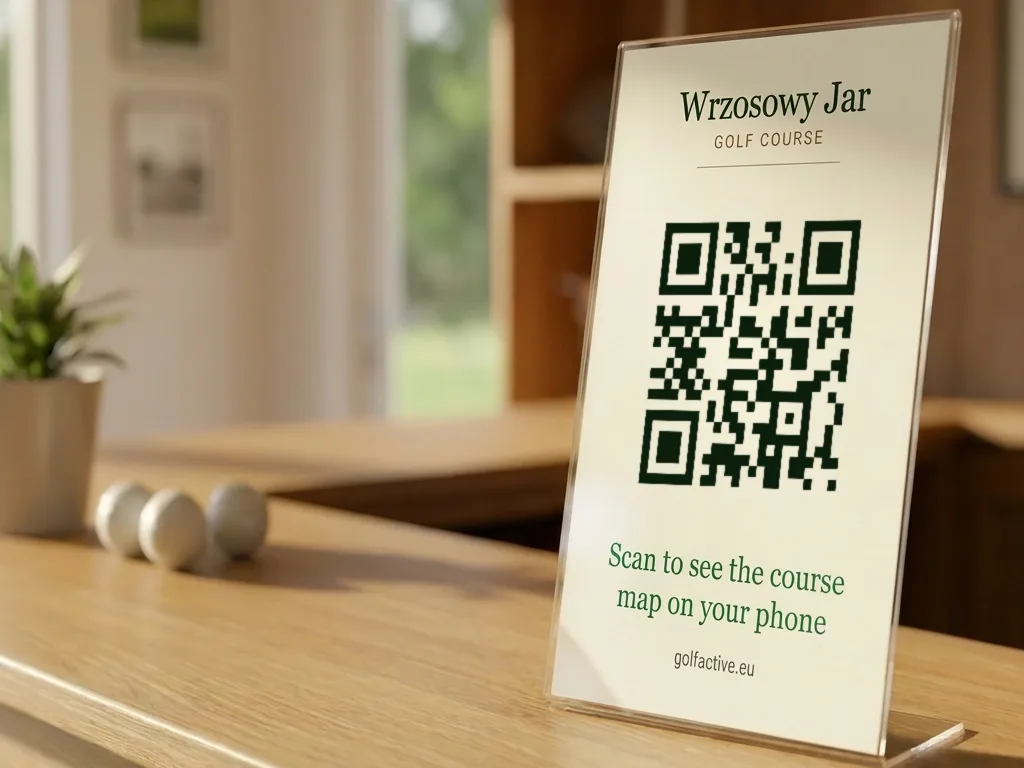
A stand at the desk and a poster by tee 1. A guest scans the
code with their phone camera, and the map opens in the browser. Your
staff don't have to explain anything — we prepare the materials
and send them print-ready.
02
A link in the confirmation email
The same address added to the tee-time confirmation. A guest opens
it on the way, or that evening at the hotel, and learns the layout
of the holes before they've even pulled into the car park.
03
A button on the club's website
“See our course” next to the booking button. For someone who's
still choosing where to play, that's a concrete argument: they can
see the course is ready for a visiting guest.
08 Pricing
The price for your course comes by email.
One product, no packages and no per-player surcharges: the price covers the whole course and everyone who plays it — and that's all you pay. Write to us: we'll send a quote for your course together with a demo, in a single message.
golfactive.us · one course
Price on requestnet, whole course quoted by return email
No fixed-term contract. Cancel any time — no notice period and no penalties.
The app at yourclub.golfactive.us — no adverts and no other courses
An interactive course map and a model of every hole
GPS navigation: front, centre and back of the green, and the pin itself
Shot planning and hazards in the line of play
A card for 2–4 players, rounds of 9 or 18 holes
Offline mode — after the first opening, the course works with no signal
Club and resort facilities, with photos
Map changes, corrections and updates — at no extra cost
The price covers the whole course and every player who steps onto it. Building the map of your course is included in the subscription.
What we don't charge extra for
Building the map, changes to it, a new photo of a facility, a corrected tee position after rebuilding, adding your club's logo, or support when something's unclear. All of it sits inside the price.
no “outside the subscription” invoices
Several courses
A group of clubs, or several courses under one operator: we quote the whole group at once, in a single message, instead of a separate conversation about each course.
one quote for the whole group
What never changes
Players pay nothing, and there's no paid version
Zero adverts — including adverts for other courses
No accounts and no collecting player data
The price doesn't grow with the number of rounds or players
09 Questions
Before you ask
Does the player have to install anything?
No — and that's the most important difference from a store app. No App Store, no account, no email, no password, no hundred-odd megabytes on a phone with no space left. All it takes is the QR code on tee 1, or a link: the map opens in the browser in two seconds. A guest who's come for one round wouldn't install an app — but they'll open this one, because it isn't an install.
Anyone who wants to can add it to their home screen with one gesture, and from then on it looks and works like a normal app, offline mode included.
Will it look like our own app?
Yes, and that's the whole point. The address is yours — yourclub.golfactive.us — and your club's logo sits in the top bar, in place of our mark, not alongside it. The course name, the accent colour and the QR code materials are yours too. A guest scanning the code at reception doesn't land on someone else's platform — they land on something that's part of the course they've just arrived at.
Two things stay ours, and we say so plainly. The map's colour palette — because it's responsible for legibility in full sun, and the colours of the fairway, green and water carry meaning that has to stay the same on every course. And the product credit in the info panel, alongside the documents and support contact. Everything a guest sees in the first second is yours.
Where do you get the map of our course?
From the course plan your club already has — usually a PDF or a graphic from your website. We place it on coordinates and redraw your course element by element: fairways, greens, bunkers, water, tree groups and paths. We verify all of it against your scorecard. We don't need a land survey or a drone flyover.
How accurate are the distances?
Accuracy has two parts: how well the map fits the terrain (on the first rollout, the average error was 1.2 m across 17 control points), and the phone's own GPS accuracy, which on open ground typically falls within 3–5 m. The app shows that second figure on screen, so the player knows what they're trusting.
Separately, we check the match against your club's own scorecard: the playing length measured on our map differs from the card by an average of 9 cm, and by less than half a metre in the worst case — measured for each of the 72 tee positions individually. That means the map agrees with the document the club itself works from — it isn't, however, a field measurement or a rangefinder verification.
Can it be used in competition play?
Rule 4.3a(1) allows devices that give distance and direction information during a round — and that's exactly what the app does. It doesn't measure elevation change or wind, which is what the Rules prohibit.
One exception: the app can suggest a club for a measured distance. That's already an interpretation of the distance, so in a competition round a player shouldn't use that suggestion — the raw numbers remain permitted. Separately, a competition committee can disable distance-measuring devices altogether with a Local Rule; in that case, no one plays with one, and our app is no exception.
Will one phone cover the whole group?
Yes — up to four players on one card. Every player has their own name, their own handicap and their own tees, so net score and Stableford points are worked out separately for each of them. Switching between players is one tap on the bar above the score entry. Nobody else needs to install anything.
What happens with no signal, or if something fails on your end?
Course geometry is saved to the phone the first time it's opened, and basemap tiles are cached during play. The GPS receiver doesn't need the internet, so distances keep being calculated. With no signal, all you lose are fresh map tiles for places nobody's been to yet — an online-only app simply stops working altogether at that point.
The same thing protects you from a failure on our end. The service level agreement guarantees 99.5 % uptime a month, with compensation if we fall short — but the design matters more than the guarantee: a hosting outage doesn't interrupt a round for anyone who's already opened the app. It only affects whoever happens to be scanning the code for the first time at that exact moment.
How long does rollout take?
Usually up to two weeks from when you send us the course plan and scorecard. Verification takes the most time: we check every hole against the scorecard and flag the ones that need a decision from the club. You don't pay for that time — the subscription only starts once the app is ready and live at your club's address.
Does the app collect player data?
There are no accounts and no registration. GPS position is processed on the phone and used solely to calculate distance — it never reaches a server and is never stored. The round's card, players' names, the history of recent rounds and club distances also stay in the phone's memory: we never see them, and clearing your browser data deletes them. The card is only sent once the player exports it themselves.
For the club, this has a concrete effect: because player data never reaches a server, there is no processing arrangement within the meaning of Article 28 GDPR. The rollout doesn't create a new register of processing activities, a data processing agreement covering player data, or data access requests for information nobody collected. Details: Privacy Policy and Terms of Service for Clubs.
Players already have free apps — do we need our own?
Your course works without it — it worked before satnav in cars, too. The thing is, a free app lives off the player's attention, and it sells that attention to whoever pays for it: a guest sees adverts and a list of other courses nearby while standing on your tee. Your course is just a record in someone else's database there — you don't decide what shows up next to it, the geometry comes from satellite imagery and user submissions, and an error reported by the club usually goes nowhere. The restaurant, the driving range and the cottages aren't on there at all, so they don't earn anything.
It's fairer to count what going without one costs: slower rounds on a full tee sheet, questions for staff instead of an order on the terrace, a guest from abroad comparing your course to the last one where they had a map in their phone. None of that shows up on a cost statement, and every one of them chips away at an impression the club has spent years building.
We'll show your course in the app.
Send us your course plan and scorecard. We'll send back a preview of your course on the map and the price — before either of us signs anything.